

Guide: Getting started with your annual plan
Things don't typically go quietly in a marketing department. Days can get busy and suddenly an opportunity for blog content, advertising or a campaign has passed you by - again.
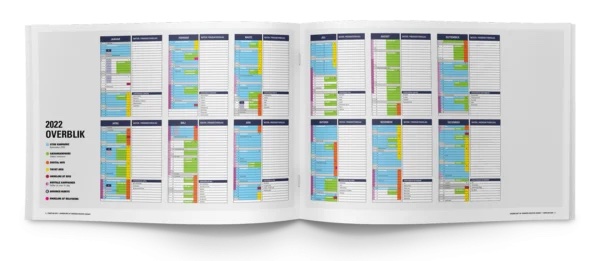
You don't have to with an annual marketing wheel! An annual plan is a visual representation of your marketing projects - big and small - throughout the year. It gives you a unique overview and lets you stay on top of activities both on and offline.
Sure, that sounds great to you. But, you might be thinking, "What's the downside? If it was that easy, wouldn't everyone do it? Wouldn't they?"
Invest time - gain time
And yes, there is a catch, if you can call it that. An annual plan requires you to set aside time to fill it with relevant information for all your marketing channels for an entire year. And it takes time to get it right. But we can also promise you that it's definitely worth the time!
You'll be left with a unique overview of all the year's activities. You will no longer forget to post an obvious post on Facebook. And you don't have to sit for 11 hours to put together a text and find a mediocre stock image that does the right thing for your message. Instead, you can sit down well in advance and prepare content for a longer period of time. Then it's just a matter of sending it out.
Are you ready to start Project-make-your-own-annual-plan? It can seem like a daunting project to create a thorough annual plan that takes the pressure off your everyday life. And it takes time and resources to do it properly. On the other hand, it's time you'll get back many times over during the year.
Here are a bunch of concrete tips that will make the process more manageable for you.
1. The most important events
Holidays and public holidays:
Once you get started on the project, it will go more smoothly than if you're looking at a blank plan. Start by plotting the easy points in the annual plan. Which holidays and anniversaries are important to your business and your customers or partners? Think about Easter, Christmas, summer vacation, Black Friday, back-to-school etc.
Go back in time and see what you've created content for in the past - and what you wish you had created content for.
If you spend a little extra time, you can also find different anniversaries that might be relevant to create content around. How about World Wide Web day? Or World Creativity and Innovation day? It can also be something as simple and cozy as Pancake Day (first Tuesday after Shrovetide - very important to remember!).

Events with direct relevance to the business:
What events take place in the company or are important to the company during the year? It could be birthdays, conferences, trade fairs, product launches or something else entirely. Think of every occasion as a relevant feature in your new annual plan.
Events with indirect relevance to the business:
You can also look at events that are important to your customers and can be indirectly linked to your company's product offering. It could be the Tour de France, World Cup, Super Bowl, Smukfest, Aarhus Festuge, DHL race, Roskilde Festival, Classic Race, Distortion... You get the idea.
Seasonal promotions and offers:
When do your customers most need the products or services you offer? Think lawnmowers in April, swimwear in July, hats and mittens in October. You need to consider when your customers' needs arise and then make sure you meet them in the moment or just before. That way, they're more likely to buy from you instead of the competition.

Your living tool
The most important thing to consider is that your content creates value for your target audiences because it will eventually create value for you.
When you feel your annual plan is coming together, remember that it's a dynamic tool. There should always be room to make additions or changes as you go along. When you go through the process again next year, you'll be happy to know that it will be both easier and more manageable.
But we're not quite there yet. You may have all the relevant elements of the annual plan in place, but you also need to consider when it's best to start drawing attention to things. This brings us to the next item on the agenda:
2. Your resources and deadlines
When?
How much?
For how long?
The answer to these questions simply depends on how big the event is and how much you want to put into it.
As a general rule of thumb, there should be content before the event to create awareness, interest and demand. In addition, of course, content should be published on the day/period when the target audience should act in a certain way; attending your event or spending money in the store.
Of course, there are exceptions. A cozy occasion, such as the aforementioned Pancake Day, doesn't need a lot of energy. One social media post on the day will probably be enough. Unless you sell pans for a living, of course.
Think about the purpose of your marketing. Can your post, blog post, landing page, campaign or Google Ad get you closer to achieving your overall goals? Let your answer be the basis for how much time and energy you can spend on it and still stay in the black.
And what about that deadline? Divide the effort into individual tasks and give them all a deadline that is both realistic and flexible. The fact is that there will almost always be unforeseen things that can disrupt plans. So set aside some extra time and make sure that A can always be completed before B so you don't get stuck or lose momentum in planning and execution.
And now for the practicalities
NOW! You've created your annual plan and are ready to dive into the many events and campaigns the year has to offer. But even after it's all plotted out, deadlines taken into account and so on, it can still feel like a daunting task to get started.
3. Don't reinvent the wheel
Many of your tasks will be similar and can be done in much the same way. For example, when creating a blog post, it will consist of the same basic elements of text, images/video and links, and the same people will likely be involved in creating them. Take advantage of this and use the resources, expertise and workflows you already have access to - it will save you tons of time and effort.
4. Take small bites of the elephant
The task may not always seem straightforward at first - just look at the implementation of an annual plan in your company. But just like in this case, breaking down your more unmanageable tasks into smaller subtasks will also help you. So "create a blog theme around online marketing trends" can become
- Research online marketing trends
- Select five exciting areas
- Seek knowledge about them and create mind maps
- Write texts
- Select visuals together with XX
- Set up in CRM and publish.
Boom. Suddenly the task became a little easier to manage, right?
5. Remember deadlines
There will always be sub-tasks that need to be completed before others can be started. For example, the overall style of the new landing page needs to be determined and the text written in the marketing department before the perfect visual material can be found by the graphic designer. Only then can the online department start setting up the site and getting it live.
Make sure you set realistic deadlines for subtasks so that everyone can complete their tasks without stressing about it. It makes for a much smoother process.
6. Dispenser, dispenser, dispenser, dispenser
After all your hard work in creating the annual plan, it will probably be your brainchild. But remember, you don't have to do every little sub-task yourself. There will undoubtedly be others in the company who are better equipped to handle some of the subtasks, and you should take advantage of that. So find yourself some talented co-conspirators who can help you bring your annual plan to life.
You can also delegate to us
Maybe you think the idea of an annual plan is brilliant. You can really see the benefits for both your own work and the company as a whole. But there simply isn't the time to do it properly. And if it can't be done properly, why even start?
This is where we can be of assistance. Let us go through the whole process on your behalf. You'll get a thorough and detailed annual plan out of it, and chances are we'll even see marketing opportunities in some of the parts of your business that you take for granted.


